Meta Description: Master 50 English ice breaker phrases for every situation. From beginner greetings to advanced idioms, learn to start conversations confidently.
Introduction
English ice breaker phrases are the key to unlocking confident communication in any social or professional setting. Whether you are walking into a party where you don’t know anyone, attending a business conference, or simply waiting in line for coffee, knowing exactly how to start a conversation can eliminate anxiety. This guide covers a comprehensive range of conversation starters, moving from simple greetings to sophisticated idioms that help you connect deeply with others.
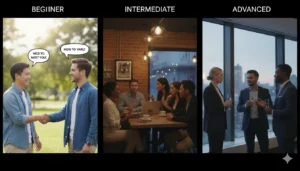
In this lesson, we break down essential phrases across three distinct levels: Beginner, Intermediate, and Advanced. You will learn the specific meaning of each phrase, see it used in accurate dialogues, and understand the context of when to use it. Hosted by PhraseCamp, this guide ensures that by the end, you will have mastered the art of “breaking the ice” and will be able to initiate chats with friends, colleagues, and strangers alike.
Watch the Video
To get the most out of this lesson on English ice breaker phrases, follow these viewing tips:
-
Watch without pausing first: Listen to the flow of the phrases to understand the natural rhythm and intonation.
-
Pause to review: After each level (Beginner, Intermediate, Advanced), pause the video to read the definitions and examples.
-
Shadow-speak: Repeat the “A” and “B” roles in the examples aloud to practice your pronunciation.
-
Focus on the specific examples: Pay attention to how the response changes based on the question asked.
Video Timestamps:
-
00:00 – Introduction
-
00:45 – Beginner Level Phrases (1–10)
-
03:20 – Intermediate Level Phrases (11–30)
-
08:15 – Advanced Level Phrases (31–50)
-
12:30 – Summary and Outro
Table of Contents
-
Beginner Level Conversation Starters
-
Beginner Key Phrases Lesson
-
Intermediate Level Conversation Starters
-
Intermediate Key Phrases Lesson
-
Advanced Level Conversation Starters
-
Advanced Key Phrases Lesson
-
Key Grammar Patterns
-
Practice Exercises
-
Knowledge Quiz
-
Conclusion
Beginner Level Conversation Starters
The foundation of any good interaction starts with simple, polite, and effective greetings. These phrases are “low risk” and can be used in almost any environment, from the grocery store to the office breakroom.
🎬 Video Timestamp: [00:45–03:20]
Complete Dialogue Transcripts
Phrase 1
Speaker A: How’s it going?
Speaker B: Pretty good, thanks. How about you?
Phrase 2
Speaker A: This is my colleague, Sarah.
Speaker B: Nice to meet you, Sarah. I’m Michael.
Phrase 3
Speaker A: How was your weekend?
Speaker B: It was relaxing. I caught up on some reading. How about yours?
Phrase 4
Speaker A: Do you live around here?
Speaker B: Yes, I have an apartment just a few blocks away. It’s a great neighborhood.
Phrase 5
Speaker A: What brings you here today?
Speaker B: I’m here for the conference. My company sent me to learn about the new technology.
Phrase 6
Speaker A: What do you do?
Speaker B: I work as a graphic designer. How about you?
Phrase 7
Speaker A: Beautiful day, isn’t it?
Speaker B: It sure is. Perfect for a walk in the park.
Phrase 8
Speaker A: Where are you from?
Speaker B: I’m originally from Boston, but I’ve been living here for 5 years now.
Key Phrases Analysis
-
“How’s it going?” — This is a casual, universal alternative to “How are you?” It invites a short, positive response rather than a deep life update.
-
“What brings you here?” — An excellent open-ended question suitable for events, parties, or conferences. It allows the other person to explain their purpose or connection to the host.
-
“Do you live around here?” — This establishes geographical common ground. It helps determine if the person is a local or a visitor, which can lead to further topics like restaurant recommendations.
-
“Beautiful day, isn’t it?” — Known as “weather talk,” this is the safest form of small talk. It creates immediate agreement (if the weather is indeed nice) and builds a bridge to other topics.
-
“What do you do?” — The standard question for asking about someone’s profession. While common, be ready to answer it yourself immediately after asking.

Beginner Key Phrases Lesson
Here we break down the specific definitions and usage rules for the most essential beginner phrases provided in the transcript.
Phrase 1: “How’s it going?”
Definition: A casual way to ask how someone is doing.
-
“How’s it going?” / “Pretty good, thanks. How about you?”
-
Additional Note: This is often spoken quickly as “How-zit-going?” in casual American English.
Phrase 5: “What brings you here?”
Definition: Asking why someone is at a particular event or place.
-
“What brings you here today?” / “I’m here for the conference. My company sent me to learn about the new technology.”
-
Usage Tip: This is more polite and conversational than asking “Why are you here?”
Phrase 6: “What do you do?”
Definition: Asking about someone’s job or profession.
-
“What do you do?” / “I work as a graphic designer. How about you?”
-
Usage Tip: In Western culture, this is a very common second or third question in a new conversation.
Intermediate Level Conversation Starters
Once you are comfortable with basic greetings, you can move to intermediate English ice breaker phrases. These allow you to connect topics, make observations, and show genuine interest in the other person’s life or hobbies.
🎬 Video Timestamp: [03:20–08:15]
Complete Dialogue Transcripts
Phrase 11
Speaker A: I couldn’t help but notice your camera. Are you a photographer?
Speaker B: Just as a hobby. I love capturing landscapes whenever I travel.
Phrase 12
Speaker A: What keeps you busy these days?
Speaker B: I just started a new project at work, plus I’m taking a Spanish class on weekends.
Phrase 13
Speaker A: Did you catch the game last night?
Speaker B: I did! That last-minute goal was incredible. Were you watching it too?
Phrase 14
Speaker A: I’ve heard great things about your company’s new product.
Speaker B: Thanks! We’ve been working on it for months. I’d be happy to tell you more about it.
Phrase 15
Speaker A: What are you up to this weekend?
Speaker B: I’m heading to the coast for a bit of hiking. The weather should be perfect for it.
Phrase 16
Speaker A: Have you heard about the new art exhibition downtown?
Speaker B: No, I haven’t. Tell me more about it. I love checking out local art.
Phrase 17
Speaker A: What do you enjoy doing in your free time?
Speaker B: I’m really into rock climbing and photography. They’re both great ways to unwind after work.
Phrase 18
Speaker A: That reminds me of a similar situation I experienced last year.
Speaker B: Really? I’d love to hear about it. What happened?
Phrase 19
Speaker A: I’m relatively new to this neighborhood. Any recommendations for good coffee shops?
Speaker B: (Implicit response inviting advice)
Phrase 20
Speaker A: What’s your take on remote work becoming more permanent?
Speaker B: I think it offers great flexibility, but I do miss the social aspects of the office sometimes.
Phrase 21
Speaker A: I’ve gone down a rabbit hole recently with urban gardening techniques.
Speaker B: That sounds fascinating. Any particular method you found most effective?
Key Phrases Analysis
-
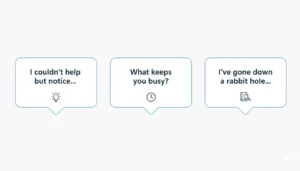
“I couldn’t help but notice…” — This is a classic observational opener. It validates that you are paying attention to the person (their camera, book, shoes, etc.) and allows them to talk about something they likely care about.
-
“What keeps you busy these days?” — A superior alternative to “What do you do?” because it allows the person to talk about work, hobbies, children, or personal projects. It feels less transactional.
-
“What’s your take on…?” — This is an excellent phrase for transitioning from small talk to “medium talk.” It asks for an opinion, showing you value their perspective.
-
“That reminds me of…” — Use this to seamlessly bridge their story into your story. It shows you are listening and connecting their experience to your own.
-
“I’ve gone down a rabbit hole…” — An idiom meaning you have become deeply (and perhaps obsessively) interested in a specific topic recently. It adds personality to the conversation.

Intermediate Key Phrases Lesson
These phrases help you sound more natural and fluent by moving beyond standard textbook questions.
Phrase 11: “I couldn’t help but notice…”
Definition: A way to start a conversation by mentioning something you observe.
-
“I couldn’t help but notice your camera. Are you a photographer?” / “Just as a hobby. I love capturing landscapes whenever I travel.”
Phrase 12: “What keeps you busy these days?”
Definition: A more interesting way to ask “What do you do?” or what they are currently working on.
-
“What keeps you busy these days?” / “I just started a new project at work, plus I’m taking a Spanish class on weekends.”
Phrase 21: “I’ve gone down a rabbit hole…”
Definition: Sharing a topic you’ve become deeply interested in lately (often obsessively).
-
“I’ve gone down a rabbit hole recently with urban gardening techniques.” / “That sounds fascinating. Any particular method you found most effective?”
Advanced Level Conversation Starters
Advanced English ice breaker phrases involve idioms, managing the flow of conversation, and establishing trust. These are particularly useful in business negotiations or when you want to deepen a friendship quickly.
🎬 Video Timestamp: [08:15–12:30]
Complete Dialogue Transcripts
Phrase 31
Speaker A: I’m on the fence about changing careers. It’s a big decision.
Speaker B: That’s understandable. What fields are you considering?
Phrase 32
Speaker A: Between you and me, I think the project deadline is too ambitious.
Speaker B: I’ve been thinking the same thing. Have you mentioned this to the team lead?
Phrase 33
Speaker A: What’s your claim to fame?
Speaker B: Well, I once won a hot dog eating contest in college. 15 hot dogs in 5 minutes.
Phrase 34
Speaker A: I have a complicated situation at work. I could use some advice.
Speaker B: I’m all ears. Tell me what’s going on.
Phrase 35
Speaker A: Let’s cut to the chase.
Speaker B: (Implicit agreement to focus on the main point)
Phrase 36
Speaker A: Honestly, it’s all about setting clear boundaries and sticking to them.
Speaker B: (Implicit agreement with the summary)
Key Phrases Analysis
-
“I’m on the fence about…” — An idiom expressing indecision. It visualizes sitting on a fence, unable to jump to one side (choice A) or the other (choice B). It invites the listener to help you decide.
-
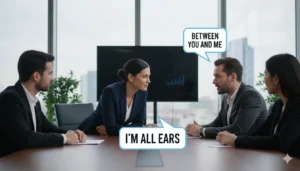
“Between you and me…” — Used to signal that what you are about to say is slightly confidential or a personal opinion not meant for everyone. It creates an immediate bond of trust.
-
“What’s your claim to fame?” — A fun, slightly humorous question asking if the person has done anything famous, unusual, or notable in their life.
-
“I’m all ears.” — An enthusiastic idiom meaning “I am listening very closely.” It is a supportive phrase to use when someone says they have a problem or a story to tell.
-
“Let’s cut to the chase.” — An idiom meaning to skip the small talk and get straight to the important point. Use this carefully; it is effective in business but can seem rude in social settings.
Advanced Key Phrases Lesson
Mastering these idioms will make your English sound sophisticated and native-like.
Phrase 31: “I’m on the fence about…”
Definition: Expressing indecision about something to invite discussion.
-
“I’m on the fence about changing careers. It’s a big decision.” / “That’s understandable. What fields are you considering?”
Phrase 33: “What’s your claim to fame?”
Definition: Asking about something interesting or notable about the person (often used humorously).
-
“What’s your claim to fame?” / “Well, I once won a hot dog eating contest in college. 15 hot dogs in 5 minutes.”
Phrase 34: “I’m all ears.”
Definition: Expressing that you are ready to listen attentively.
-
“I have a complicated situation at work. I could use some advice.” / “I’m all ears. Tell me what’s going on.”
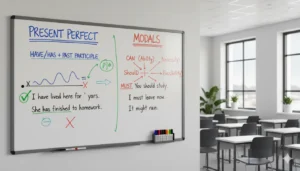
Key Grammar Patterns
To use English ice breaker phrases effectively, it helps to understand the underlying grammar that makes them work. Here are four patterns found in the dialogues.
1. Present Perfect for Trends and Changes
Use the Present Perfect (have/has + past participle) to describe actions that started in the past and continue to now, or recent news.
-
“I’ve been living here for 5 years now.” (Phrase 8) — Shows a duration continuing to the present.
-
“I’ve heard great things about your company’s new product.” (Phrase 14) — Refers to general knowledge acquired recently.
2. Modals for Possibility and Advice
Modals soften your language, making you sound more polite or open to suggestions.
-
“I could use some advice.” (Phrase 34) — “Could” is softer and less demanding than “I need advice.”
-
“I couldn’t help but notice…” (Phrase 11) — A polite way to excuse your observation of a stranger.
3. Polite Request and Clarification
Structure your questions to be inviting rather than interrogating.
-
“What brings you here today?” (Phrase 5) — Uses “What” as the subject to make the question indirect and polite.
-
“Any recommendations for good coffee shops?” (Phrase 19) — An elliptical question (dropping “Do you have…”) common in spoken English.
4. Contrast and Comparison
Connecting ideas helps maintain the flow of conversation.
-
“I think it offers great flexibility, but I do miss the social aspects…” (Phrase 20) — Using “but” to introduce a contrasting opinion politely.
-
“I’m originally from Boston, but I’ve been living here for 5 years…” (Phrase 8) — Contrasting origin with current location.
Practice Exercises
Improve your fluency by practicing these scenarios.
Exercise 1: The Networking Event (Beginner/Intermediate)
Scenario: You are at a professional conference coffee break. You see someone standing alone.
-
Objective 1: Use “I couldn’t help but notice…” to comment on something they are holding (a brochure, a coffee, a laptop).
-
Objective 2: Ask “What brings you here?” to find out their job or purpose.
-
Objective 3: Transition using “What keeps you busy these days?”
Exercise 2: The Casual Catch-up (Advanced)
Scenario: You are having lunch with a colleague you know reasonably well, but you want to discuss a sensitive work topic.
-
Objective 1: Start with “Between you and me…” to introduce the topic.
-
Objective 2: Express indecision using “I’m on the fence about…” regarding a decision you need to make.
-
Objective 3: Ask for their opinion using “What’s your take on…?”
Video Shadow-Speaking Challenge
Steps:
-
Go to timestamp 08:15 (Advanced Phrases).
-
Listen to Phrase 34 (“I’m all ears”).
-
Pause and repeat Speaker B’s line: “I’m all ears. Tell me what’s going on.”
-
Record yourself on your phone and compare your intonation to the video. Does your voice sound interested and supportive?
Knowledge Quiz
Test your understanding of the English ice breaker phrases and their definitions.
1. What is the best meaning of “I’m on the fence”?
a) I am sitting outside.
b) I am undecided about a decision.
c) I am trying to escape a situation.
d) I am defending my opinion.
2. Which phrase is best used to start a conversation by observing something?
a) Let’s cut to the chase.
b) What’s your claim to fame?
c) I couldn’t help but notice…
d) Between you and me…
3. In the dialogue, how does the speaker answer “What brings you here?”
a) “I drove my car.”
b) “I live around here.”
c) “I’m here for the conference.”
d) “I’m originally from Boston.”
4. If someone says “I’m all ears,” what are they promising to do?
a) Talk a lot.
b) Listen attentively.
c) Give you a medical exam.
d) Leave the conversation.
5. Which phrase signals that a conversation is becoming confidential?
a) Beautiful day, isn’t it?
b) What keeps you busy these days?
c) Between you and me…
d) That reminds me of…
Answers:
-
b
-
c
-
c
-
b
-
c
Scoring Guide:
-
5/5: Expert Communicator! You are ready to break the ice anywhere.
-
3-4/5: Good conversationalist. Review the Advanced section again.
-
1-2/5: Beginner. Focus on mastering the first 10 phrases before moving on.
Conclusion
By mastering these English ice breaker phrases, you have equipped yourself with the tools to navigate social landscapes with confidence. You are no longer just learning vocabulary; you are learning how to connect with people. Whether you are using a simple “How’s it going?” or a sophisticated “I’m on the fence about…”, you now have the right words for the right moment.
Summary of Key Phrases:
-
Beginner: “What brings you here?” — Establishing purpose.
-
Beginner: “Do you live around here?” — Finding common ground.
-
Intermediate: “I couldn’t help but notice…” — Observational opener.
-
Intermediate: “What’s your take on…?” — Asking for opinions.
-
Advanced: “Between you and me…” — Building trust.
-
Advanced: “Let’s cut to the chase.” — Direct business communication.
Your Next Steps:
-
Choose 3 phrases from the Beginner list and use them tomorrow.
-
Identify one “rabbit hole” topic you are interested in so you can answer that question if asked.
-
Practice the “I’m on the fence” structure for a decision you are currently making.
-
Watch the video again and focus purely on intonation.
“I’m all ears. Tell me what’s going on.”
If you found this lesson helpful, please subscribe to our YouTube channel for more speaking practice.
Business Enquiries: support@phrasecamp.com
Facebook: facebook.com/phrasecamp
© 2025 PhraseCamp. All rights reserved.
Tags: English ice breaker phrases, conversation starters, ESL speaking practice, business English, social English, learn English, English vocabulary, beginner English, advanced English idioms, networking skills, small talk, communication skills, English fluency, IELTS speaking, public speaking, daily English