Master 3 beginner English conversations on AI language learning, mental health, and online shopping. ESL dialogues with key vocabulary and practice exercises.
Beginner English conversations on trending, real-world topics are one of the best ways for A2–B1 learners to build everyday fluency fast. Whether you are curious about AI language-learning tools, need to talk about stress and mental health at work, or want to shop online with confidence, the three dialogues in this guide cover the conversations everyone is having right now.
This lesson features three complete beginner-to-intermediate English conversations covering Learning Languages with AI, Mental Health and Wellness, and Online Shopping and Digital Payments. After the dialogues you will find a Key Vocabulary Review with six essential phrases you can start using immediately. By the end of this article, you will be ready to discuss these popular topics naturally and confidently.
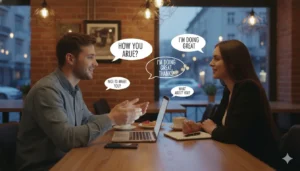
Watch the Complete Beginner English Conversations Video
Before we break down each conversation, watch our video featuring all three dialogues plus a Key Vocabulary Review. Hearing the natural pronunciation and pace will help you understand how these conversations sound in real life:
How to Use This Video:
- First viewing: Watch without pausing to get the overall flow
- Second viewing: Pause after each dialogue to review unfamiliar words
- Third viewing: Shadow-speak along with the characters for pronunciation practice
- Fourth viewing: Focus on the Key Vocabulary Review at the end
Video Timestamps:
- 00:00 – Introduction
- Dialogue 1 – Learning Languages with AI (Maya & Alex)
- Dialogue 2 – Mental Health and Wellness (Sarah & Dr. Martinez)
- Dialogue 3 – Online Shopping and Digital Payments (Jenny & Tom)
- Key Vocabulary Review – 6 essential phrases with examples
Table of Contents
- Watch the Complete Beginner English Conversations Video
- Conversation 1: Learning Languages with AI (Maya & Alex)
- Conversation 2: Mental Health and Wellness (Sarah & Dr. Martinez)
- Conversation 3: Online Shopping and Digital Payments (Jenny & Tom)
- Key Vocabulary Review: 6 Essential Phrases
- Key Grammar Patterns for Beginner Conversations
- Practice Exercises and Role-Play Scenarios
- Beginner English Conversations Knowledge Quiz
- Conclusion
Conversation 1: Learning Languages with AI (Maya and Alex)
This conversation introduces how AI technology can help English learners practice speaking, grammar, and pronunciation. Maya asks curious beginner questions while Alex explains popular AI tools in simple, practical terms.
🎬 Video: Dialogue 1 – Learning Languages with AI
Complete Dialogue:
Maya: Everyone keeps talking about AI for learning English. What exactly is AI?
Alex: Oh, Maya! AI stands for Artificial Intelligence. It’s like having a really smart computer that can help you practice English anytime.
Maya: Really? But how does a computer help me speak better English?
Alex: Great question. So there are apps like ChatGPT, where you can have conversations. The AI talks back to you and corrects your mistakes.
Maya: Wow. But is it expensive? I’m a student, you know.
Alex: Actually, many AI tools are free. You can use ChatGPT, Google Translate, and even practice pronunciation with apps like Elsa.
Maya: Can I use it on my phone while I’m on the bus?
Alex: Absolutely. That’s the best part. You can practice anywhere. Yesterday, I was waiting for coffee and practiced speaking with an AI tutor for 10 minutes.
Maya: But what about grammar? I always make mistakes with past tense.
Alex: Perfect! AI is amazing at grammar. You can ask it, “Is this sentence correct?” And it explains why or why not. It’s like having a teacher in your pocket.
Maya: This sounds incredible! I want to try it today. Can you show me how to start?
Alex: Of course. Let’s download an app right now. In one month, you’ll be amazed at your progress.
Maya: Thank you so much! I feel like English learning just became much easier.
Key Phrases Analysis:
- “What exactly is AI?” — “What exactly is…?” is a natural way to ask for a clear explanation of something you don’t understand
- “It’s like having a really smart computer” — Using “It’s like…” to explain something complex with a simple comparison — very common in everyday English
- “You can practice anywhere” — Emphasizing convenience and flexibility — “anywhere” and “anytime” are powerful beginner words
- “It’s like having a teacher in your pocket” — A vivid metaphor that makes an abstract idea (AI) feel concrete and relatable
- “In one month, you’ll be amazed at your progress” — Using future tense with a time frame to encourage and motivate someone

Conversation 2: Mental Health and Wellness (Sarah and Dr. Martinez)
This dialogue covers a sensitive and important topic: managing stress and building confidence while learning English for work. Sarah speaks with Dr. Martinez about feeling overwhelmed, and receives practical advice including breathing exercises, positive self-talk, and setting boundaries in meetings.
🎬 Video: Dialogue 2 – Mental Health and Wellness
Complete Dialogue:
Sarah: Dr. Martinez. I’m feeling overwhelmed lately. Between learning English for my job and work pressure, I can’t cope anymore.
Dr. Martinez: I understand, Sarah. Many professionals face this challenge. Let’s talk about managing stress while achieving your language goals.
Sarah: It’s just so much. My boss expects perfect English in meetings, but I still struggle with confidence. Sometimes I feel like giving up.
Dr. Martinez: Those feelings are completely normal. First, let’s address the perfectionism. Even native speakers make mistakes in meetings.
Sarah: Really? I never thought about that. But how do I build confidence when speaking English at work?
Dr. Martinez: Great question. We can use mindfulness techniques combined with language practice. Have you tried breathing exercises before presentations?
Sarah: No, I haven’t. How does breathing help with English speaking?
Dr. Martinez: When we’re anxious, our breathing becomes shallow. Deep breathing calms your mind and helps you think more clearly. This makes finding English words easier.
Sarah: That makes sense. What other techniques can help me?
Dr. Martinez: Positive self-talk is powerful. Instead of thinking “My English is terrible,” try “I’m improving every day.” Your brain believes what you tell it.
Sarah: I do say negative things to myself. I need to change that habit. But what about work pressure from my colleagues?
Dr. Martinez: Set boundaries, Sarah. You can say, “Let me think about that,” if you need time to formulate your thoughts in English. Most people appreciate honesty.
Sarah: I never thought about asking for thinking time. That could really help in meetings. This conversation has been so helpful.
Dr. Martinez: I’m glad to hear that. Remember, mental health and language learning support each other. When you’re relaxed, you learn faster.
Sarah: You’re absolutely right. I’ll practice these techniques this week. Thank you for helping me see things differently.
Key Phrases Analysis:
- “I’m feeling overwhelmed lately” — A professional, honest way to express that stress has become too much to manage
- “I can’t cope anymore” — “Cope” means to deal with a difficult situation — “I can’t cope” signals you need help
- “Those feelings are completely normal” — A reassuring response that validates someone’s emotions without dismissing them
- “Let me think about that” — A boundary-setting phrase for meetings — gives you time to formulate thoughts in English without pressure
- “Mental health and language learning support each other” — Connecting two ideas to show a positive relationship — useful structure for discussions

Conversation 3: Online Shopping and Digital Payments (Jenny and Tom)
This practical conversation covers the vocabulary and phrases you need to shop online safely in English. Jenny asks Tom about different payment options, online security, and the risks of “buy now, pay later” services.
🎬 Video: Dialogue 3 – Online Shopping and Digital Payments
Complete Dialogue:
Jenny: Tom. I’m trying to buy something online, but there are so many payment options. What’s the difference?
Tom: Don’t worry, Jenny. Let me explain the most common ones. Credit cards are the most popular for online shopping.
Jenny: Why credit cards? Isn’t it dangerous to put my card number online?
Tom: Good question. Reputable websites use secure encryption. Look for “https” in the website address and a lock symbol.
Jenny: What about PayPal? My friend always uses that.
Tom: PayPal is excellent for beginners. You don’t share your card details with the store. PayPal protects your information.
Jenny: Hmm… That sounds safer. What about those “buy now, pay later” options I keep seeing?
Tom: Be careful with those. They can lead to debt if you’re not careful. Only use them if you’re sure you can pay on time.
Jenny: Thanks for the advice. I’ll stick with PayPal for now. Online shopping doesn’t seem so scary anymore.
Key Phrases Analysis:
- “What’s the difference?” — A simple, versatile question for comparing two or more options — works in any context
- “Isn’t it dangerous to…?” — A negative question that expresses concern while asking for reassurance — natural in everyday English
- “Look for “https” and a lock symbol” — Giving specific, actionable advice rather than vague warnings
- “Be careful with those” — “Be careful with…” is a friendly way to give a warning or caution without sounding harsh
- “I’ll stick with PayPal for now” — “Stick with” means to stay with a choice you feel comfortable with — very natural English

Key Vocabulary Review: 6 Essential Phrases
At the end of the video, the narrator reviews the six most important phrases from all three conversations. Here they are with definitions and examples:
Phrase 1: “What exactly is…?”
Use this phrase when you want a clear explanation of something you don’t understand. It works for any topic.
- “What exactly is virtual reality?”
- “What exactly is cryptocurrency?”
- “What exactly is the difference between these two plans?”
Phrase 2: “…anytime.”
This means whenever you want. It emphasizes convenience and flexibility.
- “I can study anytime.”
- “You can call me anytime.”
- “The app is available anytime you need it.”
Phrase 3: “I’m feeling overwhelmed.”
Use this to express stress in a professional, honest way. It is clear without being dramatic.
- “I’m feeling overwhelmed with work.”
- “I’m feeling overwhelmed by all the new information.”
- “She told her manager she was feeling overwhelmed.”
Phrase 4: “How do I cope with…?”
Use this when asking for help with a difficult situation. “Cope with” means to manage or deal with something challenging.
- “How do I cope with stress?”
- “How do I cope with a heavy workload?”
- “How do I cope with learning a new language?”
Phrase 5: “What’s the difference?”
Use this when comparing two or more options. It is one of the most common questions in everyday English.
- “What’s the difference between these two?”
- “What’s the difference between a debit card and a credit card?”
- “What’s the difference between “effect” and “affect”?”
Phrase 6: “Be careful with…”
Use this to give a friendly warning or advice. It is direct but not harsh.
- “Be careful with online payments.”
- “Be careful with “buy now, pay later” services.”
- “Be careful with sharing personal information online.”
Key Grammar Patterns for Beginner Conversations
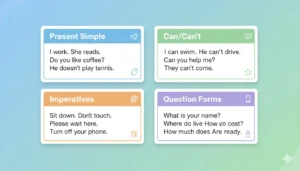
These grammar patterns appear across all three conversations. Understanding them will help you sound more natural at the A2–B1 level.
Present Simple for Facts and General Truths:
- “AI stands for Artificial Intelligence” — stating a definition or fact
- “Credit cards are the most popular for online shopping” — describing a general truth
Can/Can’t for Ability and Possibility:
- “You can practice anywhere” — expressing possibility
- “I can’t cope anymore” — expressing inability
Imperatives for Advice and Instructions:
- “Look for https in the website address” — giving clear instructions
- “Be careful with those” — giving a warning
- “Set boundaries, Sarah” — giving direct advice
Questions with “How” and “What”:
- “How does a computer help me speak better English?” — asking about a process
- “What’s the difference?” — asking for a comparison
- “What exactly is AI?” — asking for a definition
Practice Exercises and Role-Play Scenarios
Exercise 1: AI Language Learning Role-Play
Scenario: A friend asks you what AI is and how it can help them learn English. Explain it simply, like Alex does with Maya.
- Use “What exactly is…?” to start the conversation
- Name at least two free AI tools and explain what they do
- Use “anytime” and “anywhere” to describe the convenience
Exercise 2: Mental Health Discussion
Scenario: You are feeling stressed about work and English learning. Talk to a friend or counselor using Sarah and Dr. Martinez’s conversation as a model.
- Use “I’m feeling overwhelmed” to describe your situation
- Practice saying “Let me think about that” as a boundary-setting phrase
- Share one positive self-talk sentence you could use
Video Shadow-Speaking Challenge:
- Play the video at 0.75x speed and shadow-speak one dialogue at a time
- Focus on the Key Vocabulary Review and repeat each phrase with the narrator
- Record yourself saying all six key phrases and compare with the video
- Use at least one phrase in a real conversation this week
Beginner English Conversations Knowledge Quiz
Test your understanding of the three conversations and six key phrases:
Question 1: According to Alex, what does AI stand for?
- a) Automatic Intelligence
- b) Artificial Intelligence
- c) Advanced Internet
- d) Applied Information
Question 2: What does Dr. Martinez recommend instead of negative self-talk?
- a) Ignoring your feelings
- b) Speaking only in your native language
- c) Positive self-talk, such as “I’m improving every day”
- d) Avoiding meetings entirely
Question 3: What should you look for to know a website is secure?
- a) A green background on the page
- b) The word “safe” in the website name
- c) “https” in the address and a lock symbol
- d) A large font size
Question 4: What does “I can’t cope anymore” mean?
- a) I don’t want to try
- b) I am unable to manage a difficult situation any longer
- c) I need a vacation
- d) I am feeling happy
Question 5: Why does Tom say “Be careful” about “buy now, pay later” options?
- a) They are illegal
- b) They can lead to debt if you don’t pay on time
- c) They only work with credit cards
- d) They are only available in certain countries
Answers:
- b) Artificial Intelligence
- c) Positive self-talk, such as “I’m improving every day”
- c) “https” in the address and a lock symbol
- b) I am unable to manage a difficult situation any longer
- b) They can lead to debt if you don’t pay on time
How did you score?
- 5/5: Excellent! You understood all three conversations perfectly.
- 3–4/5: Good work! Review the conversations where you missed answers.
- 1–2/5: Keep practicing! Re-watch the video and re-read the dialogues.
Conclusion: Build Everyday English Confidence with Real Conversations
The three conversations and six key phrases in this guide cover some of the most talked-about topics right now. Here is a recap of what you have mastered:
Conversation 1 — Learning Languages with AI (Maya & Alex):
- “What exactly is…?” — asking for clear explanations
- “…anytime” — emphasizing convenience and flexibility
Conversation 2 — Mental Health and Wellness (Sarah & Dr. Martinez):
- “I’m feeling overwhelmed” — expressing stress professionally
- “How do I cope with…?” — asking for help with difficult situations
Conversation 3 — Online Shopping and Digital Payments (Jenny & Tom):
- “What’s the difference?” — comparing options
- “Be careful with…” — giving friendly warnings
Your Next Steps:
- Watch the video for pronunciation guidance and natural flow
- Use at least one new phrase in a real conversation this week
- Download the worksheet and take the quiz above
- Subscribe to our YouTube channel for new lessons every week
Remember, as Dr. Martinez says: “When you’re relaxed, you learn faster.” Take it one conversation at a time.
🎥 Subscribe to our YouTube channel for weekly English conversation lessons!
www.youtube.com/englishphrasecamp
If this article helped you, please like, share, and subscribe for more English learning content!
Business enquiries: support@phrasecamp.com
Facebook page: https://www.facebook.com/phrasecamp
All material, information and videos are owned by PhraseCamp © 2025
#phrasecamp #englishphrasecamp
Tags:
beginner English conversations, ESL beginner dialogues, A2-B1 English practice, AI English learning, mental health English vocabulary, online shopping English, English conversation practice, ESL speaking practice, English for beginners, AI language learning English, digital payments English, positive self-talk English, English key phrases, PhraseCamp, ESL conversation topics, everyday English dialogues