Skip to content
Practicing B1-B2 English conversations on real-world topics is one of the fastest ways for intermediate ESL students to build fluency and confidence. Whether you are preparing for international meetings, discussing environmental issues, or trying to boost your productivity at work, the three dialogues in this guide will give you the vocabulary and professional expressions you need to sound natural.
This lesson features three complete intermediate-to-upper-intermediate English conversations covering Remote Work Communication, Environmental Sustainability, and Workplace Productivity. Each dialogue is followed by a Key Phrases Lesson with three professional expressions you can start using immediately, taught by our host Rachel. By the end, you will have mastered nine essential phrases for professional and academic English.

Watch the Complete B1-B2 English Conversations Video
Before we analyze each conversation in detail, watch our video featuring all three B1-B2 level dialogues. Hearing the natural pronunciation and flow will help you understand how these conversations sound in real-life professional situations:
How to Use This Video:
- First viewing: Watch without pausing to get the overall flow
- Second viewing: Pause after each conversation to review vocabulary
- Third viewing: Shadow-speak along with the dialogue for pronunciation practice
- Fourth viewing: Focus on Rachel’s key phrases after each dialogue
Video Timestamps:
- 00:00 – Introduction with Rachel
- 01:04 – Conversation 1: Remote Work Communication
- 04:06 – Key Phrases Lesson 1
- 05:50 – Conversation 2: Environmental Sustainability
- 08:42 – Key Phrases Lesson 2
- 10:35 – Conversation 3: Workplace Productivity
- 11:59 – Key Phrases Lesson 3
- 13:30 – Outro and practice challenge
Table of Contents
- Watch the Complete B1-B2 English Conversations Video
- Conversation 1: Remote Work Communication (James & Lisa)
- Key Phrases Lesson 1: Professional Workplace Expressions
- Conversation 2: Environmental Sustainability (Emma & Professor Chen)
- Key Phrases Lesson 2: Discussion and Analysis Expressions
- Conversation 3: Workplace Productivity (Colleague & David)
- Key Phrases Lesson 3: Productivity and Expectation Expressions
- Key Grammar Patterns for B1-B2 Conversations
- Practice Exercises and Role-Play Scenarios
- B1-B2 English Conversations Knowledge Quiz
- Free Worksheet Download
- Conclusion
Conversation 1: Remote Work Communication (James and Lisa)
This conversation demonstrates how two colleagues discuss the challenges of communicating remotely in English, including technical problems, cross-cultural sensitivity, and professional follow-up strategies.
🎬 Video Timestamp: 01:04–04:06
Complete Dialogue:
James: Lisa, I’m struggling with remote communication in English. Yesterday’s video call was a disaster. I couldn’t express my ideas clearly.
Lisa: I’ve been there, James. Remote communication is challenging, even for native speakers. What specifically went wrong during the meeting?
James: Well, there were technical issues with my microphone and when I finally could speak, I forgot all my prepared talking points.
Lisa: Technology problems happen to everyone. The key is having backup plans. Do you test your equipment before important meetings?
James: Honestly, no. What’s your pre-meeting routine?
Lisa: I have a checklist. 15 minutes before—test camera, microphone, internet connection. I also prepare key phrases written down for reference.
James: Key phrases? Like what kind of phrases?
Lisa: Professional expressions for virtual meetings. “Could you repeat that, please? The audio cut out.” Or, “I’d like to build on Sarah’s point.” These give you confidence and sound natural.
James: That’s brilliant! But what about cultural differences? Our team has people from six different countries.
Lisa: Excellent point. Cross-cultural communication requires extra sensitivity. Americans might be very direct, while Japanese colleagues prefer indirect communication styles.
James: How do I adapt to everyone’s style? It sounds complicated.
Lisa: It’s not as difficult as it seems. Focus on clarity and patience. Speak slightly slower, use simple sentence structures, and always confirm understanding.
James: Should I turn my camera on all the time? Some people seem to prefer cameras off.
Lisa: It depends on company culture and meeting purpose. For team meetings and presentations, definitely camera on. For quick status updates, it’s usually optional.
James: I see. I need to observe the team’s patterns more carefully. What about following up after meetings?
Lisa: Always send a summary email. Include key decisions, action items, and deadlines. This ensures everyone understood the same thing, regardless of language barriers.
James: This advice is invaluable. I feel much better prepared for tomorrow’s client presentation. Thanks for sharing your expertise.
Lisa: You’re welcome. Remember, remote communication skills take time to develop. You’ll be leading virtual teams yourself soon enough.
Key Phrases Analysis:
- “I’m struggling with remote communication” — A polite, professional way to admit difficulty without sounding incompetent
- “The key is having backup plans” — “The key is…” is a common structure for introducing the most important solution
- “Could you repeat that, please? The audio cut out” — A polite request for repetition that explains why you missed information
- “I’d like to build on Sarah’s point” — A sophisticated way to add to a colleague’s idea in a meeting
- “Always send a summary email” — Professional follow-up with key decisions, action items, and deadlines

Key Phrases Lesson 1: Professional Workplace Expressions
Rachel teaches three phrases after each dialogue. Here are the expressions from Conversation 1:
Phrase 1: “I’m struggling with…”
This means you have difficulty with something. It is polite and professional.
- “I’m struggling with this computer program.”
- “I’m struggling with my presentation.”
- “I’m struggling with the new software update.”
Phrase 2: “Let me finish this point.”
This means please wait, I want to complete my idea. Use this when someone interrupts you.
- “Let me finish this point, then you can ask questions.”
- “Let me finish this point about the budget.”
Phrase 3: “Just to confirm…”
This means to check if you understand correctly. It prevents mistakes.
- “Just to confirm, the meeting is at 3 PM?”
- “Just to confirm, you want the red or blue design?”
- “Just to confirm, the deadline is next Friday?”
Conversation 2: Environmental Sustainability (Emma and Professor Chen)
This dialogue follows a student asking her professor about how ordinary people can contribute to environmental sustainability. The conversation uses academic discussion language essential for B1-B2 learners.
🎬 Video Timestamp: 05:50–08:42
Complete Dialogue:
Emma: Professor Chen, climate change seems overwhelming for individuals. How can ordinary people make meaningful contributions to environmental sustainability?
Professor Chen: That’s a fundamental question, Emma. While individual actions might seem insignificant, collective behavior changes can drive substantial environmental improvements.
Emma: Could you elaborate on that? What specific actions have the most significant impact?
Professor Chen: Research indicates three primary areas: energy consumption, transportation choices, and consumption patterns. For instance, reducing meat consumption can decrease your carbon footprint by up to 30%.
Emma: 30%? That’s substantial! But what about people who aren’t ready to become vegetarians?
Professor Chen: Gradual transitions are perfectly acceptable. Meatless Mondays or choosing locally sourced proteins can still make considerable differences. Sustainability isn’t about perfection. It’s about progress.
Emma: That’s a refreshing perspective. What role does renewable energy play in individual sustainability efforts?
Professor Chen: Renewable energy adoption is accelerating rapidly. Solar panel costs have decreased by 70% in the past decade, making home installations increasingly accessible.
Emma: What about people living in apartments? Not everyone can install solar panels.
Professor Chen: Excellent point. Community solar programs, energy-efficient appliances, and supporting renewable energy policies through voting are alternative approaches.
Emma: Speaking of policies, how important is political engagement in environmental issues?
Professor Chen: Absolutely crucial. Corporate emissions account for approximately 70% of global greenhouse gases. Individual actions are important, but systemic changes require policy interventions.
Emma: So we need both personal responsibility and political activism. How do we balance these approaches effectively?
Professor Chen: Precisely. Personal actions demonstrate commitment and create social proof, while political engagement addresses structural problems. Each reinforces the other.
Emma: This gives me hope. What’s one piece of advice you’d give to someone just starting their sustainability journey?
Professor Chen: Start small, but think systematically. Choose one area, perhaps transportation, and make consistent improvements. Document your progress and share your experiences with others.
Key Phrases Analysis:
- “Could you elaborate on that?” — A polite, academic way to ask for more detail
- “Research indicates three primary areas” — “Research indicates…” sounds more credible than “I think…”
- “Sustainability isn’t about perfection. It’s about progress” — A memorable parallel structure that reframes expectations
- “Corporate emissions account for approximately 70%” — “Account for” means “make up” or “represent” a proportion
- “Each reinforces the other” — Describes a mutually beneficial relationship between two approaches

Key Phrases Lesson 2: Discussion and Analysis Expressions
Rachel’s second Key Phrases Lesson teaches three expressions for discussing important topics:
Phrase 1: “The relationship between…”
This means how two things connect or affect each other.
- “The relationship between sleep and health is important.”
- “I study the relationship between exercise and mood.”
- “The relationship between carbon emissions and global temperatures is well documented.”
Phrase 2: “That’s where [something] becomes powerful.”
This means that is the point when something becomes very effective.
- “That’s where teamwork becomes powerful.”
- “That’s where technology becomes powerful.”
Phrase 3: “The return on investment typically occurs within…”
This means when you get your money or effort back after investing in something.
- “The return on investment typically occurs within two years.”
- “The return on investment typically occurs within six months.”
Conversation 3: Workplace Productivity (Colleague and David)
This shorter conversation follows a stressed colleague asking David for practical time-management advice. It demonstrates how to ask for help professionally and receive actionable solutions.
🎬 Video Timestamp: 10:35–11:59
Complete Dialogue:
Colleague: David, I’m drowning in tasks and meetings. How do successful professionals manage their time effectively?
David: Time management is crucial for career advancement. Let’s discuss some evidence-based strategies that actually work.
Colleague: Please! I’m working 10-hour days but still falling behind on deadlines.
David: That suggests inefficient task prioritization rather than insufficient time. Do you use any systematic approach to organize your workload?
Colleague: Honestly, I just respond to whatever seems most urgent. I guess that’s not very strategic.
David: Exactly. Try the Eisenhower Matrix. Categorize tasks by urgency and importance. Focus on important but not urgent tasks to prevent crises.
Colleague: That makes sense, but what about all these unnecessary meetings? Half my day disappears in video calls.
David: Meeting fatigue is real. Propose agenda-driven meetings with clear objectives. Decline meetings where your input isn’t essential.
Colleague: I never thought I could decline meetings. These strategies could transform my productivity. Thank you for the practical advice.
Key Phrases Analysis:
- “I’m drowning in tasks and meetings” — A powerful metaphor meaning you have far too much to handle
- “That suggests inefficient task prioritization rather than insufficient time” — A sophisticated analysis using “rather than” to contrast two explanations
- “Try the Eisenhower Matrix” — Giving a specific, named framework rather than vague advice
- “Meeting fatigue is real” — A short, emphatic validation that acknowledges the problem
- “Decline meetings where your input isn’t essential” — Empowering someone to set boundaries professionally

Key Phrases Lesson 3: Productivity and Expectation Expressions
Rachel’s final Key Phrases Lesson covers three expressions for discussing work and productivity:
Phrase 1: “I’m drowning in…”
This means you have too much of something and feel overwhelmed.
- “I’m drowning in emails today.”
- “I’m drowning in homework this week.”
Phrase 2: “Set clear expectations.”
This means tell people exactly what you want or need.
- “Let me set clear expectations about the deadline.”
- “We should set clear expectations about meeting times.”
Phrase 3: “Quality over quantity.”
This means it is better to do fewer things well than many things poorly.
- “For this project, quality over quantity.”
- “When studying, remember quality over quantity.”
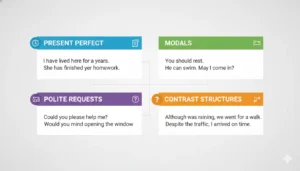
Key Grammar Patterns for B1-B2 Conversations
Several grammar patterns appear across all three conversations. Mastering these will help you sound more natural at the intermediate level.
Present Perfect for Trends and Changes:
- “Solar panel costs have decreased by 70%” — change over a time period
- “I’ve been there, James” — shared past experience
Modals for Possibility and Advice:
- “Individual actions might seem insignificant” — possibility
- “Try the Eisenhower Matrix” — imperative for direct advice
Polite Request and Clarification:
- “Could you repeat that, please?” — softer than “Can you”
- “Could you elaborate on that?” — formal request for detail
- “Just to confirm…” — checking understanding
Contrast and Comparison:
- “While individual actions might seem insignificant, collective behavior changes can drive substantial improvements” — “While” for concession
- “That suggests inefficient prioritization rather than insufficient time” — “Rather than” for contrast
Practice Exercises and Role-Play Scenarios
Exercise 1: Remote Work Role-Play
Scenario: You had a difficult video call yesterday. Tell a colleague what went wrong and ask for advice, following James and Lisa’s format.
- Use “I’m struggling with…” to describe your challenge
- Ask at least two follow-up questions
- Use “Just to confirm…” to check your understanding of their advice
Exercise 2: Sustainability Discussion
Scenario: You are a student asking a teacher about environmental sustainability, following Emma and Professor Chen’s format.
- Use “Could you elaborate on that?” at least once
- Include at least one statistic in your discussion
- Discuss both individual actions and systemic changes
Video Shadow-Speaking Challenge:
- Play the video at 0.75x speed and shadow-speak one conversation at a time
- Focus on Rachel’s Key Phrases at timestamps 04:06, 08:42, and 11:59
- Record yourself saying each of the nine key phrases and compare with Rachel
- Follow Rachel’s challenge: use at least one phrase at work or school this week
B1-B2 English Conversations Knowledge Quiz
Test your understanding of the three conversations and nine key phrases:
Question 1: What does Lisa recommend doing 15 minutes before an important meeting?
- a) Review your presentation slides
- b) Test camera, microphone, and internet connection
- c) Send an email to all participants
- d) Practice your talking points with a colleague
Question 2: According to Professor Chen, what can reduce your carbon footprint by up to 30%?
- a) Using public transportation
- b) Installing solar panels
- c) Reducing meat consumption
- d) Recycling household waste
Question 3: What framework does David recommend for task prioritization?
- a) The Pomodoro Technique
- b) Getting Things Done (GTD)
- c) The Eisenhower Matrix
- d) The Pareto Principle
Question 4: What does “I’m drowning in tasks” mean?
- a) You enjoy having many tasks
- b) You have too much work and feel overwhelmed
- c) You are working near water
- d) You need to learn how to swim
Question 5: What percentage of global greenhouse gases do corporate emissions account for?
- a) 30%
- b) 50%
- c) 70%
- d) 90%
Answers:
- b) Test camera, microphone, and internet connection
- c) Reducing meat consumption
- c) The Eisenhower Matrix
- b) You have too much work and feel overwhelmed
- c) 70%
How did you score?
- 5/5: Excellent! You’re ready for confident professional conversations.
- 3–4/5: Good work! Review the conversations where you missed answers.
- 1–2/5: Keep practicing! Re-watch the video and re-read the dialogues.
Free B1-B2 English Conversations Worksheet Download
Download our free practice worksheet to reinforce everything you learned in this lesson:
- Vocabulary matching from all 3 conversations
- Fill-in-the-blank exercises using the actual dialogues
- Role-play scenarios based on the situations covered
- Video-linked listening comprehension questions with timestamps
- Complete answer key with explanations
Conclusion: Master Intermediate English for Real-World Success
The three conversations and nine key phrases in this guide cover some of the most important topics in professional and academic English today. Here is a quick recap of what you have mastered:
Conversation 1 — Remote Work Communication (James & Lisa):
- “I’m struggling with…” — describing difficulties professionally
- “Let me finish this point.” — maintaining your voice in meetings
- “Just to confirm…” — preventing miscommunication
Conversation 2 — Environmental Sustainability (Emma & Professor Chen):
- “The relationship between…” — analytical discussions
- “That’s where [something] becomes powerful.” — emphasizing turning points
- “The return on investment typically occurs within…” — business justifications
Conversation 3 — Workplace Productivity (Colleague & David):
- “I’m drowning in…” — expressing overwhelm vividly
- “Set clear expectations.” — professional alignment
- “Quality over quantity.” — prioritizing excellence
Your Next Steps:
- Watch the video for pronunciation guidance
- Follow Rachel’s challenge: use at least one new phrase this week
- Download the worksheet and take the quiz
- Subscribe to our YouTube channel for new lessons every week
Remember, as Professor Chen says: “Sustainability isn’t about perfection. It’s about progress.” The same is true for learning English.
🎥 Subscribe to our YouTube channel for weekly English conversation lessons!
www.youtube.com/englishphrasecamp
Recommended Next Reading:
8 Advanced English Conversations for Real-Life Scenarios (ESL Learners) — Continue building your conversation skills with our comprehensive guide.
If this article helped you, please like, share, and subscribe for more English learning content!
Business enquiries: support@phrasecamp.com
Facebook page: https://www.facebook.com/phrasecamp
All material, information and videos are owned by PhraseCamp © 2026
#phrasecamp #englishphrasecamp #esl #englishspeaking #intermediateesl #B1-B2 English conversations